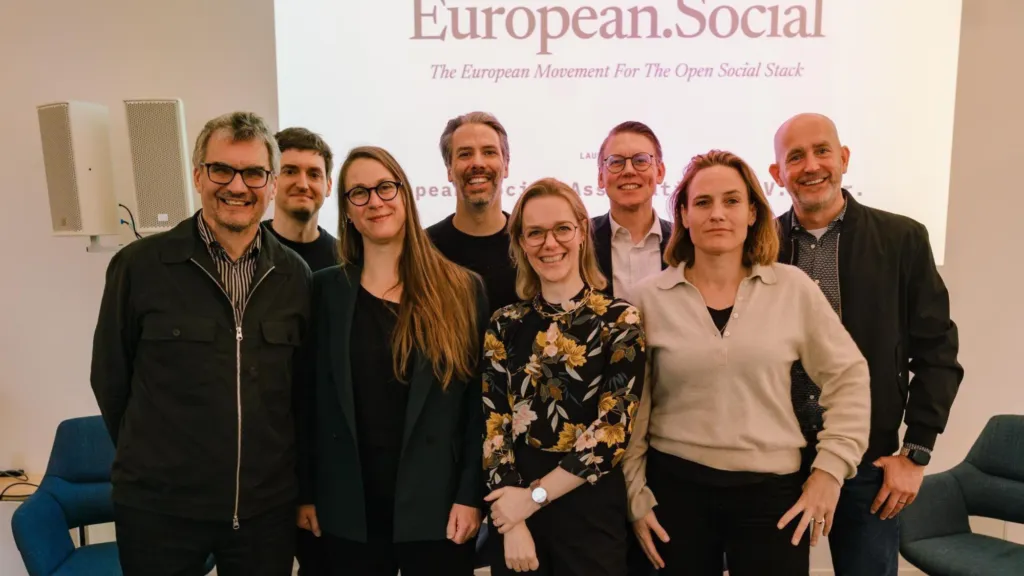
Today, November 4, the European.Social movement was officially launched in Berlin with a celebratory event at the location of Wikimedia Deutschland. The movement takes on a legal form in the European Social Association e.V., which was also established today. The association will coordinate the movement for open, decentralised and interoperable social media in Europe. More than 150 organisations and almost 700 individuals support the initiative, including PublicSpaces.
From manifesto to organisation
European.Social began as a shared manifesto, launched on 5 June 2026 at the PublicSpaces Conference with 12 founding signatories – including PublicSpaces. Since then, the movement has grown with 40 builders, 14 communities, 86 organisations and 676 individuals. Together, they are building open social infrastructure for Europe from a set of shared values and principles like democracy, digital autonomy and open source.
The newly formed association is a not-for-profit led by civil society. It brings together civil society organisations, communities, technology developers, public media and researchers working towards a European open social stack: a shared digital infrastructure that enables people and organisations to communicate and collaborate independently of the dominant commercial platforms.
Who is behind it?
The association was founded and is supported by representatives of different parts of the network: Michael Foster (Newsmast Foundation), Sophie Bloemen (Commons Network), Jantien Borsboom (PublicSpaces), Björn Staschen (Save Social – Networks For Democracy), Felix Hlatky (Mastodon), Sebastian Vogelsang (Eurosky), Cathleen Berger (Open Social Web Alliance) and Sander van der Waal (Waag Futurelab, oso.social).
Why now?
The founding coincides with growing political attention for European digital sovereignty. In the European Commission’s Open Source Strategy, part of the Technological Sovereignty Package, decentralised social media is one of four areas in which the Commission and the Member States want to support open alternatives.
What will European.Social do?
The collaboration will focus on shared infrastructure projects and on organising broad support for open social media in Europe. The founders will continue to work on a governance structure that enables all participants to collaborate. The first annual gathering is planned for June 2027, alongside the PublicSpaces Conference in Amsterdam.
According to co-convenors Michael Foster and Björn Staschen, Europe needs an open, interoperable and community-driven social infrastructure that reflects Europe’s democratic values and serves the public interest. What began as a declaration is now becoming an organisation capable of turning shared principles into concrete action.
How does this tie in with developments in the Netherlands?
In the Netherlands, PublicSpaces works with public and civil society organisations from various sectors in ‘TheNextSocials’ to create a landscape of decentralised social media platforms that are truly social. Our collaboration with European.Social enables us to tackle certain major challenges – such as building bridges between protocols or high-level moderation – at European level.
Furthermore, it is of great value to the Dutch TheNextSocials movement to be able to exchange knowledge and join forces regarding developments within the open social web in various European countries; to work together to build a larger European movement and to have joint representation at European level.
Join in
Organisations, institutions, developers, communities and individuals across Europe can join. More information is available at European.Social.